
My approach
Psychodynamic Therapy in Washington, DC
Psychodynamic psychotherapy in Washington, DC, starts from the understanding that our emotional lives are shaped by our relationships, personal histories, and the social and cultural worlds we inhabit. Some of these influences remain outside our awareness, yet continue to shape how we feel, understand ourselves, and relate to others.
It offers a space to explore these experiences, recognize patterns that may contribute to emotional suffering, and discover new possibilities for change. Grounded in contemporary relational psychoanalysis and my training at the Institute of Contemporary Psychotherapy and Psychoanalysis (ICP+P), I work with individuals and couples in English, Spanish, and Portuguese, in person at my Woodley Park office and through telehealth in DC, Maryland, and New York.
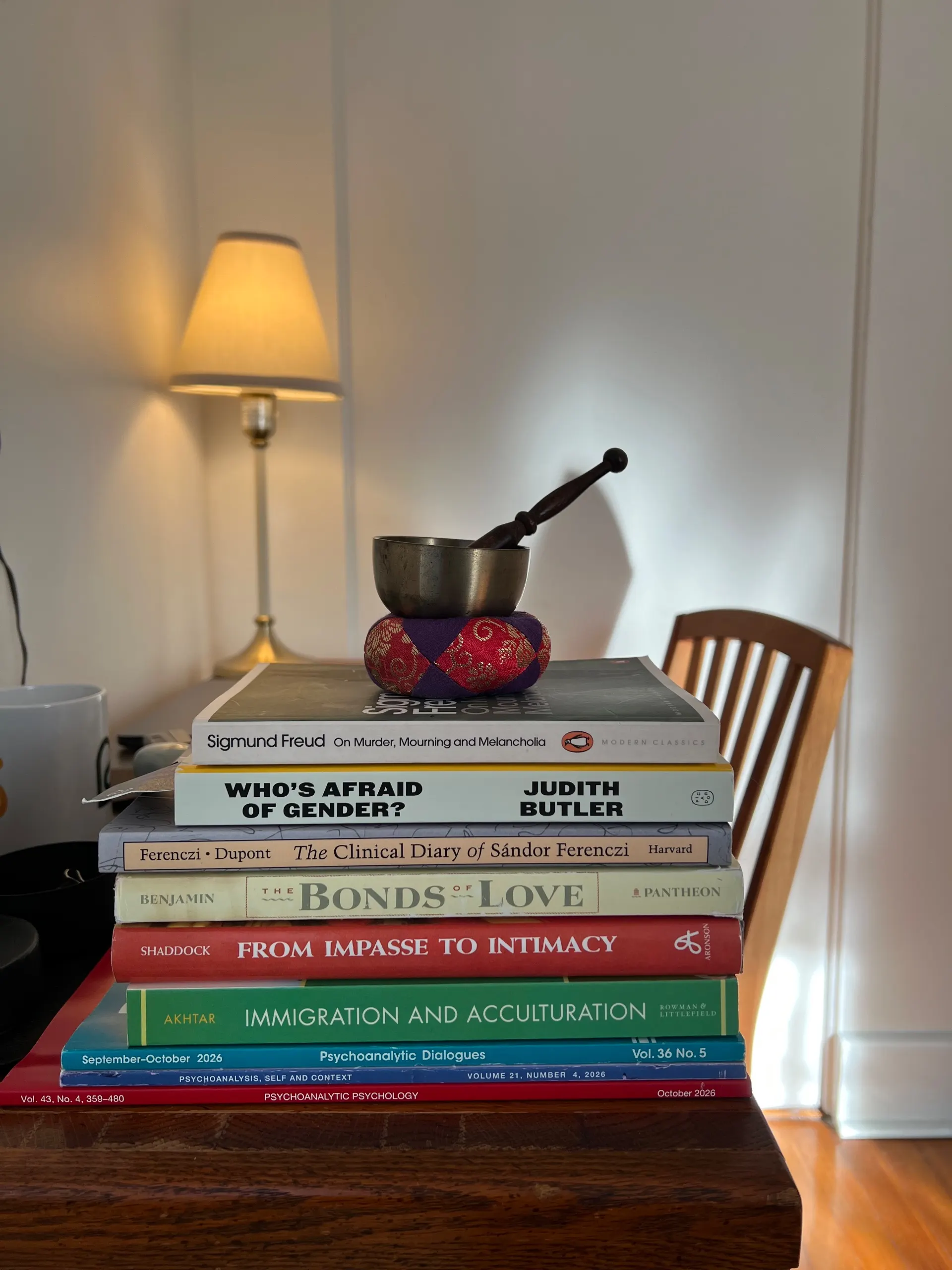
What Psychodynamic Therapy Explores
As a psychodynamic therapist in Washington, DC, I offer a space to explore feelings that are difficult to put into words, recurring patterns, and relationships that have shaped who we are. Our bodies may also offer clues to emotional experiences we have not yet fully understood.
My approach is grounded in empathic listening and a genuine, collaborative therapeutic relationship. Together, we explore your experiences with curiosity and openness, including how our relationships and social and cultural contexts shape our emotional lives.
The aim is to deepen self-understanding, discover new ways of relating to ourselves and others, and open possibilities for meaningful change.

What Shapes My Work
Psychoanalytic training
I completed the Certificate in Advanced Psychodynamic Psychotherapy in 2015 and the Certificate in Psychoanalysis in 2022, both at the Institute of Contemporary Psychotherapy and Psychoanalysis (ICP+P) in Washington, DC.
Teaching and ongoing learning
At ICP+P, I chair the Fellowship Program and serve on the faculty. I continue my professional development through individual supervision with Jay Frankel, PhD, known for his work on trauma and relational dynamics, and group supervision with Jessica Benjamin, PhD, a leading contributor to relational and intersubjective psychoanalysis.
Contemporary psychoanalytic thinking
My approach draws on Relational Psychoanalysis, Self Psychology, and intersubjective perspectives, with particular attention to how gender, culture, race, ethnicity, power, and social class shape our emotional lives and relationships.
Living between cultures
Living outside my native culture, far from family and my first language, has deepened my understanding of belonging and the many meanings of home. This experience also informs my sensitivity to how others navigate cultural differences, identity, and belonging.
Three languages
Language carries memories, emotions, and ways of experiencing the world. I offer psychotherapy in English, Spanish, and Portuguese. I am also a guest editor of a special issue of Psychoanalytic Inquiry devoted to Latin voices in psychoanalysis.
A path through health care
I began my professional career as a pediatric physical therapist, developing an appreciation for human development, the connection between body and mind, and the importance of relationships. I later earned a Master of Public Health and a master's degree in psychology.
Psychodynamic Therapy, Psychoanalysis, and CBT
Each of these approaches helps many people. Psychodynamic psychotherapy and psychoanalysis are rooted in the same foundational principles, and the key difference lies in frequency. Cognitive behavioral therapy (CBT) comes from a different tradition.
| Psychodynamic psychotherapy | Psychoanalysis | Cognitive behavioral therapy (CBT) | |
|---|---|---|---|
| Main focus | Patterns, relationships, and feelings that may be difficult to put into words | The same, explored more intensively | Thoughts and behaviors in the present |
| How often | Typically one to two sessions per week | Typically three to four sessions per week | Often once a week, with exercises between sessions |
| How long | No fixed length, usually longer-term | No fixed length, usually longer-term | Often a set number of sessions |
| The therapy relationship | Part of the work itself | Part of the work itself | A working partnership toward set goals |
| Often chosen by | People who wish to understand what keeps repeating | People who wish to explore more intensively | People who want focused work on a specific symptom |
| In my practice | Yes | Yes | No |
Who This Work May Be For

“There are patterns in my life that I recognize but find difficult to change.”
Individual psychotherapy“We love each other, but somehow we keep hurting one another.”
Couples therapy“I feel disconnected from myself and from things that once mattered to me.”
Depression & life transitions“I don't just want to feel better. I want to understand why I feel the way I do.”
Psychodynamic psychotherapy“I have built a life far from home, but I sometimes feel I belong in neither place.”
Therapy for immigrants & expats“This loss has brought up feelings and memories I wasn't expecting.”
Grief & loss
Fees for Psychodynamic Therapy
- Individual therapy is $200 and couples therapy is $250 per 50-minute session.
- I am out-of-network. Payment is charged to your card during the week of each session, and you receive a detailed receipt (a superbill) that you can submit to your insurance.
$200Individual session
$250Couples session
50-minute sessions
Verifiable
Licensed in DC, Maryland & New York
- Washington DCLicensed Professional Counselor (LPC)PRC200002045Verify licenseSearch license number PRC200002045 under Professional Counseling.
- MarylandLicensed Clinical Professional Counselor (LCPC)LC6508Verify license
- New YorkLicensed Mental Health Counselor (LMHC)009246Verify license
- Federal registryNational Provider Identifier (NPI)1174754766Look up NPI
Education & professional experience
Educational background
- Spring 2027Foundations in Family Therapy course, Ackerman Institute, New York City
- OngoingIndividual supervision with Jay Frankel, PhD, and group supervision with Jessica Benjamin, PhD
- 2022Certificate in Psychoanalysis, ICP+P, Washington, DC
- 2015Certificate in Advanced Psychodynamic Psychotherapy, ICP+P, Washington, DC
- 2010Master's degree in psychology, Argosy University, Chicago
- 2007Master of Public Health, University of Illinois Chicago
- 1991Bachelor's degree in physical therapy, Ciências Médicas de Minas Gerais, Brazil
Professional experience
- Since 2018Psychotherapist and psychoanalyst in private practice
- Since 2013The Lourie Center for Children's Social and Emotional Wellness
- Since 2022Chair of the Fellowship Program, ICP+P, and a faculty member there
- 2026Guest editor, Psychoanalytic Inquiry: "Latin Voices" (vol. 46, no. 2)
- ForthcomingGuest co-editor, Psychoanalytic Inquiry: "Psychoanalysis & Digital Technologies"
- 2021Circle of Security for Educators
- 2015Circle of Security for Parents
Written by Adriana Couto Silva, LPC (DC), LCPC (MD), LMHC (NY). Last reviewed: November 25, 2026
About Adriana Couto SilvaQuestions About Psychodynamic Therapy
What is psychodynamic therapy?
It is a talk therapy that explores how your personal history and relationships shape what you feel today, including influences that may be difficult to recognize. Through conversation and reflection, we can begin to recognize familiar patterns and discover new ways of relating to yourself and others.
How is psychodynamic therapy different from CBT?
CBT usually focuses on thoughts and behaviors in the present, often with exercises between sessions. Psychodynamic therapy explores deeper patterns and relationships, and the relationship between us is part of the work. Both help many people, and the right one depends on what you are looking for.
Does psychodynamic therapy work?
For many people, a deeper understanding of themselves and their relationships opens possibilities for meaningful change over time. I cannot promise a result, because each person's experience is different.
How long does psychodynamic therapy take?
There is no fixed length. It is usually longer than approaches focused only on symptoms. We talk about it along the way, and therapy reaches a natural and purposeful end that we decide together.
How often are psychodynamic therapy sessions?
Psychodynamic psychotherapy typically involves one to two sessions per week, and psychoanalysis three to four. Sessions last 50 minutes, and we decide the rhythm together.
What is the difference between psychodynamic therapy and psychoanalysis?
Both are rooted in the same foundational principles, and the key difference lies in frequency. Depending on your needs and preferences, you may choose between them.
Are you a psychoanalyst in Washington, DC?
Yes. I completed my psychoanalytic training at ICP+P in Washington, DC, in 2022, and I am a faculty member there. My licenses are LPC in DC, LCPC in Maryland, and LMHC in New York.
Do I have to talk about my childhood?
No. We start from what brings you to therapy. Earlier experiences may come up over time, at a pace that feels right for you.
Will my therapist just sit in silence?
No. My approach is one of active, empathic listening, and I take part in the conversation. Some people arrive with a lot to say, and others need more time. There is room for both.
Do you offer psychodynamic therapy in Spanish or Portuguese?
Yes. I offer it in English, Spanish, and Portuguese, for individuals and couples, in person in Washington, DC, or by video in DC, Maryland, and New York.
First step
Book a Free 20-Minute Consultation
Please do not include medical details in this form.
Prefer to call or email? (301)204-1608 · contact@asilvapsychotherapy.com